.png)


.png)
When we spoke in 2024, you had recently become a Fellow of the Royal Astronomical Society (RAS). Can you share one experience, connection or opportunity since then that has meaningfully shaped your path?
Since becoming a Fellow, the biggest shift has been access to a genuine global network of astronomers and astrophysicists, people who are remarkably accomplished yet remarkably humble. Talking with them regularly has been humbling in the best way. RAS had given me clarity that I never knew I needed: that pure theory alone is not enough, practicality too is. Essentially, having practical knowledge (say, systems engineering) is as important as it is to be a pure theorist (say, pure math/ theoretical physics). That combination has reshaped how I think about my own path forward.
Take us back to the beginning of your work with NASA. How did the opportunity arise, and what did you have to do to prepare for it?
It started at an American Astronomical Society conference, where I met Dr. Ronald Gamble, a Cosmic Origins Scientist at NASA Goddard. He invited me into NASA's Cosmic Pathfinder Program and the ASTRA Initiative, which led to meeting other key people, including Peter Goldman, NASA's Astrophysics Division Director. The team liked the ideas I presented on future space mission concepts and design, and that led to an ongoing collaboration with NASA's Astrophysics Division. To prepare, I've had to keep learning across astronomy, astrophysics, and cosmology, while also training myself in systems engineering and mission design, skills not typically taught in a physics classroom.

Before a space mission can become a reality, someone must first develop the idea behind it. What does that process look like, and what have you found most surprising about it?
It starts with knowing the field well enough to spot gaps: questions we can't yet answer, or theories that haven't been properly tested. From there it's literature review, pattern recognition, and hypothesis-building, which eventually takes shape as a formal mission concept proposal following NASA's standards. What surprised me most is how disciplined that formalization process is. It forces you to think in terms of what's actually buildable and testable, not just what's theoretically elegant, which was a real shift in how I approach problems. I was surprised to see how efficient the formalization process is that NASA uses; it literally forces you to think in terms of practical necessities rather than just theorizing like pure math or theoretical physics, which I now believe to be a limited perspective.
You are contributing to a group connected to the Habitable Worlds Observatory, a future telescope that will help scientists study planets beyond our solar system. What big question are you hoping this work will help answer, and what is it like to be the group’s only undergraduate?
The big question is the oldest one there is: are we alone in the universe? HWO will be able to directly image and study Earth-sized planets orbiting in the "Goldilocks zone" of Sun-like stars, the distance where conditions could support liquid water, while also helping us understand how stars are born and how galaxies grow over time. Being the only undergraduate in the group is intimidating and humbling, honestly, but it's also the best possible place to be: surrounded by ideas and mentorship I couldn't get anywhere else.
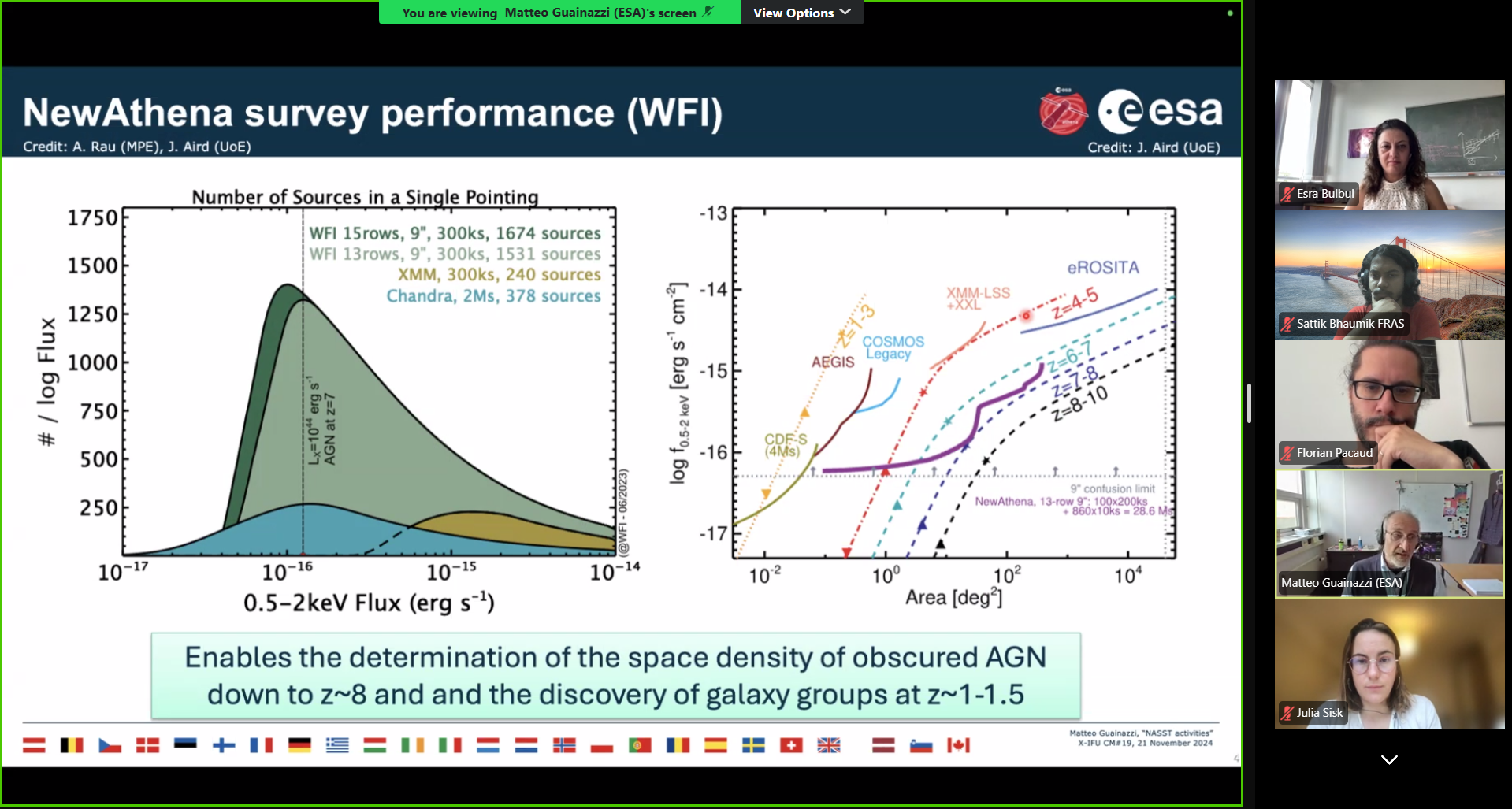
Another part of your work focuses on the European Space Agency’s Athena telescope. What might this telescope allow us to see or understand that we cannot today, and how is your team helping prepare for that?
NewAthena will let us "see" the enormous web of super-hot gas that connects galaxies across the universe, matter that's invisible to us right now, and look far enough back in time to watch the very first supermassive black holes forming. Understanding that early history helps explain why galaxies, and the universe as a whole, look the way they do today. My role within the NewAthena Science Community involves helping build the science tools and data standards that researchers will rely on once the telescope actually launches.
Think of a specific moment during this work when something you learned at Minerva proved useful. What did you draw upon, and how did it help you contribute?
Resilience! Minerva becomes challenging with multiple courses and tracks, and pushing through those builds the kind of perseverance I now lean on constantly in this work. It also taught me to think outside conventional academic paths, and that skill-building matters as much as following the "expected" track. Both of those lessons show up daily when I'm working through problems that don't have a clear textbook answer. The idea is to become capable, and success will chase after you! Everything comes to us that belongs to us if we create the capacity to receive it. Yes, we live in a modern world which rewards super-specialists but generalists and polymaths have seen the larger picture.
--
Where could your curiosity take you? Explore how Minerva’s approach to learning can help you build the skills to pursue big questions and chart your own path.
Quick Facts
Computational Sciences
Computational Sciences
Natural Sciences
Computational Sciences
Arts & Humanities, Natural Sciences
Social Sciences & Arts and Humanities
Business
Computational Sciences
Computational Sciences
Social Sciences & Business
Computational Sciences
Social Sciences
Computational Sciences & Business
Business & Computational Sciences
Computational Sciences
Computational Sciences
Social Sciences & Business
Business
Natural Sciences
Social Sciences
Social Sciences
Social Sciences & Business
Business & Computational Sciences
Business and Social Sciences
Social Sciences and Business
Computational Sciences & Social Sciences
Computer Science & Arts and Humanities
Business and Computational Sciences
Business and Social Sciences
Natural Sciences
Arts and Humanities
Business, Social Sciences
Business & Arts and Humanities
Computational Sciences
Natural Sciences, Computer Science
Computational Sciences
Arts & Humanities
Computational Sciences, Social Sciences
Computational Sciences
Computational Sciences
Natural Sciences, Social Sciences
Social Sciences, Natural Sciences
Data Science, Statistics
Computational Sciences
Business
Computational Sciences, Data Science
Social Sciences
Natural Sciences
Business, Natural Sciences
Business, Social Sciences
Computational Sciences
Arts & Humanities, Social Sciences
Social Sciences
Computational Sciences, Natural Sciences
Natural Sciences
Computational Sciences, Social Sciences
Business, Social Sciences
Computational Sciences
Natural Sciences, Social Sciences
Social Sciences
Arts & Humanities, Social Sciences
Arts & Humanities, Social Science
Social Sciences, Business
Arts & Humanities
Computational Sciences, Social Science
Natural Sciences, Computer Science
Computational Science, Statistic Natural Sciences
Business & Social Sciences
Sustainability
Sustainability
Natural Sciences & Sustainability
Natural Sciences
Sustainability
Computational Sciences
Computational Sciences
Computational Science & Business
Data Science and Statistics
Data Science and Statistics, Digital Practices
Earth and Environmental Systems
Cognition, Brain, and Behavior & Philosophy, Ethics, and the Law
Computational Theory and Analysis
Computer Science and Artificial Intelligence
Brand Management & Computer Science and Artificial Intelligence
Computer Science and Artificial Intelligence
Economics and Society & Strategic Finance
Enterprise Management
Economics and Society
Cells and Organisms & Brain, Cognition, and Behavior
Cognitive Science and Economics & Political Science
Applied Problem Solving & Computer Science and Artificial Intelligence
Computer Science and Artificial Intelligence & Cognition, Brain, and Behavior
Designing Societies & New Ventures
Strategic Finance & Data Science and Statistics
Brand Management and Designing Societies
Data Science & Economics
Machine Learning
Cells, Organisms, Data Science, Statistics
Arts & Literature and Historical Forces
Artificial Intelligence & Computer Science
Cells and Organisms, Mind and Emotion
Economics, Physics
Managing Operational Complexity and Strategic Finance
Global Development Studies and Brain, Cognition, and Behavior
Scalable Growth, Designing Societies
Business
Drug Discovery Research, Designing and Implementing Policies
Historical Forces, Cognition, Brain, and Behavior
Artificial Intelligence, Psychology
Designing Solutions, Data Science and Statistics
Data Science and Statistic, Theoretical Foundations of Natural Science
Strategic Finance, Politics, Government, and Society
Conversation
When we spoke in 2024, you had recently become a Fellow of the Royal Astronomical Society (RAS). Can you share one experience, connection or opportunity since then that has meaningfully shaped your path?
Since becoming a Fellow, the biggest shift has been access to a genuine global network of astronomers and astrophysicists, people who are remarkably accomplished yet remarkably humble. Talking with them regularly has been humbling in the best way. RAS had given me clarity that I never knew I needed: that pure theory alone is not enough, practicality too is. Essentially, having practical knowledge (say, systems engineering) is as important as it is to be a pure theorist (say, pure math/ theoretical physics). That combination has reshaped how I think about my own path forward.
Take us back to the beginning of your work with NASA. How did the opportunity arise, and what did you have to do to prepare for it?
It started at an American Astronomical Society conference, where I met Dr. Ronald Gamble, a Cosmic Origins Scientist at NASA Goddard. He invited me into NASA's Cosmic Pathfinder Program and the ASTRA Initiative, which led to meeting other key people, including Peter Goldman, NASA's Astrophysics Division Director. The team liked the ideas I presented on future space mission concepts and design, and that led to an ongoing collaboration with NASA's Astrophysics Division. To prepare, I've had to keep learning across astronomy, astrophysics, and cosmology, while also training myself in systems engineering and mission design, skills not typically taught in a physics classroom.
Before a space mission can become a reality, someone must first develop the idea behind it. What does that process look like, and what have you found most surprising about it?
It starts with knowing the field well enough to spot gaps: questions we can't yet answer, or theories that haven't been properly tested. From there it's literature review, pattern recognition, and hypothesis-building, which eventually takes shape as a formal mission concept proposal following NASA's standards. What surprised me most is how disciplined that formalization process is. It forces you to think in terms of what's actually buildable and testable, not just what's theoretically elegant, which was a real shift in how I approach problems. I was surprised to see how efficient the formalization process is that NASA uses; it literally forces you to think in terms of practical necessities rather than just theorizing like pure math or theoretical physics, which I now believe to be a limited perspective.
You are contributing to a group connected to the Habitable Worlds Observatory, a future telescope that will help scientists study planets beyond our solar system. What big question are you hoping this work will help answer, and what is it like to be the group’s only undergraduate?
The big question is the oldest one there is: are we alone in the universe? HWO will be able to directly image and study Earth-sized planets orbiting in the "Goldilocks zone" of Sun-like stars, the distance where conditions could support liquid water, while also helping us understand how stars are born and how galaxies grow over time. Being the only undergraduate in the group is intimidating and humbling, honestly, but it's also the best possible place to be: surrounded by ideas and mentorship I couldn't get anywhere else.
Another part of your work focuses on the European Space Agency’s Athena telescope. What might this telescope allow us to see or understand that we cannot today, and how is your team helping prepare for that?
NewAthena will let us "see" the enormous web of super-hot gas that connects galaxies across the universe, matter that's invisible to us right now, and look far enough back in time to watch the very first supermassive black holes forming. Understanding that early history helps explain why galaxies, and the universe as a whole, look the way they do today. My role within the NewAthena Science Community involves helping build the science tools and data standards that researchers will rely on once the telescope actually launches.
Think of a specific moment during this work when something you learned at Minerva proved useful. What did you draw upon, and how did it help you contribute?
Resilience! Minerva becomes challenging with multiple courses and tracks, and pushing through those builds the kind of perseverance I now lean on constantly in this work. It also taught me to think outside conventional academic paths, and that skill-building matters as much as following the "expected" track. Both of those lessons show up daily when I'm working through problems that don't have a clear textbook answer. The idea is to become capable, and success will chase after you! Everything comes to us that belongs to us if we create the capacity to receive it. Yes, we live in a modern world which rewards super-specialists but generalists and polymaths have seen the larger picture.
--
Where could your curiosity take you? Explore how Minerva’s approach to learning can help you build the skills to pursue big questions and chart your own path.