.png)


What inspired you to pursue work in military history, defense policy, and archival storytelling — areas where women are still underrepresented?
I’ve always had an interest in military history since the age of ten, and that has taken many forms as I’ve grown, from creative writing to nonfiction research, to visiting Normandy and doing commemorative work, to my current focus on foreign policy.
It’s definitely true that women are underrepresented in this space, but that alone isn’t the reason for (or against) what I pursue. While it would, of course, be nice to have more diversity in the field, I realize that everybody has their own unique interests — this just so happens to be mine : )
What’s the common thread linking your work in military history, defense policy, writing, and teaching, and why is that theme important to you?
Two main streams: a long-lasting interest in military history and a passion for creative writing. Everything else is either built on those interests, and/or is an intersection of them.
In your research on World War I and military history, have you encountered stories of women that deserve more attention, and how does that influence the way you approach historical storytelling?
Not so much in WWI, but when I returned to Normandy this past June, I had the opportunity to meet 2nd Lt. Betty Rosevear, who was a nurse in the Philippines during the war. Her story is incredible (I won’t repeat it here, as it’s linked above), and she turned 104 while we were in Normandy! I definitely try to highlight lesser-known people and stories through my work, especially after meeting so many who deserve more attention. It is reality, though, that there are simply fewer resources available (especially primary sources, if you’re dealing with history), which makes it harder to research and write.
What kinds of projects are you most focused on right now, and how has your Minerva experience helped prepare you for this work?
Most of my work has shifted to forward-looking foreign policy (with the exception of the military history book I am preparing for publication right now). I write for the NATO Association of Canada, specifically the NATO & Canada, and Canadian Armed Forces programs, and also am a contributor to OpenCanada, the Canadian International Council’s magazine.
As a junior, I am also planning my capstone, a quantitative foreign policy research paper investigating whether the structure of the international system (how power is distributed among great powers) predicts the frequency of serious military disputes. Using 200 years of conflict data and statistical modeling, I test whether multipolar systems produce more militarized confrontations than bipolar or unipolar ones, and apply those findings to assess the structural risk profile of the current U.S.–China rivalry.
Minerva’s global rotation + cultural immersion has allowed me to experience the “end product” of foreign policy, as well as provided opportunities to chat with/interview locals about threat perception and other concerns.
Across your experience working in international policy spaces — including the NATO Association of Canada — what issues have most shaped your perspective, and what experience most influenced how you see your future path?
Since I have entered the foreign policy space, the main issue has been the US’s shift to the so-called “Donroe Doctrine” and its implications for other countries (I am particularly interested in Canada and China), military alliances (like NATO), and foreign interventions. It’s an interesting time, as the unipolar global order is coming to an end, and I would like to be involved in researching the future development of the global system.
You’ve worked on historical publications ranging from World War I archival materials to helping bring memoirs and student writing into print. What draws you to the process of helping historical stories reach readers?
Many important lessons can be learned from history, and we have the privilege of retrospect when analyzing events from the past. I am particularly interested in historical narratives and investigating how humanity has changed over time given different circumstances. In short, humans never change, only our circumstances do, so we need to learn from history how to best adapt to them.
Generally, I feel that it’s our duty as the next generation to carry on these personal stories — especially those from veterans — as war can too easily be understood only as big numbers and statistics. But once you look at the individual soldier, sailor, etc. you realize that every person impacted by war has a personal story; it’s by realizing this shared humanity that we can hope to prevent further wars in the future.
I expanded on this idea as it relates to my Normandy trip here. For the letter project/book specifically, the story of these two soldiers would forever be lost/forgotten if nobody from the present time bothered to tell it, and I think it’s an honor that I get to.
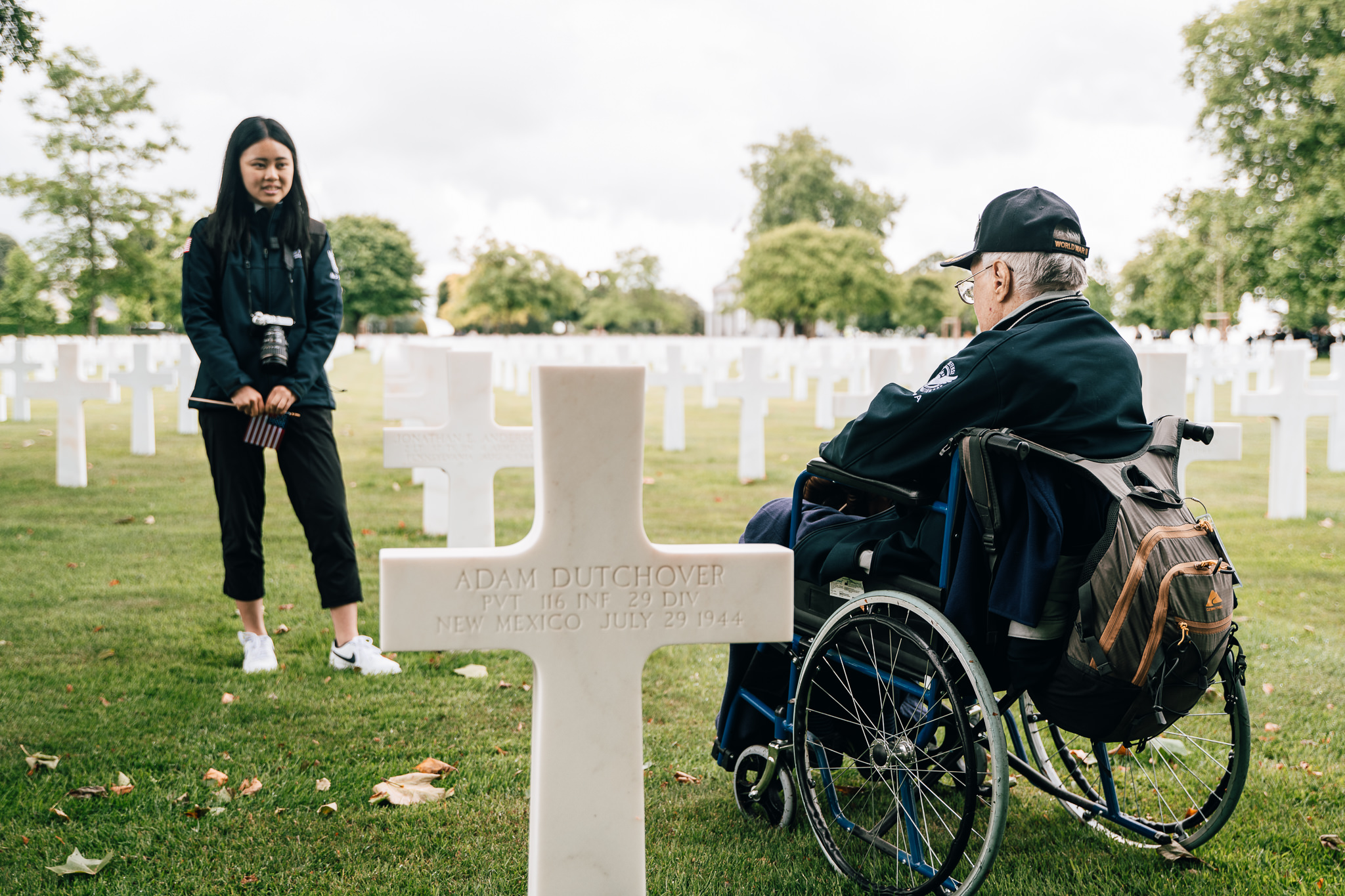
You had the opportunity to return to Normandy alongside WWII veterans for the D-Day anniversary. Was there a moment from that experience that has stayed with you, and what did it teach you about memory, history, and honoring lived experience?
On June 6th (D-Day), we were at the Overlord Museum and I got to witness and photograph a reunion between SSGT. George Mullins of the 101st Airborne with a Normandy-native, Raymond Rivoal, who was an 8-year-old orphan during the war. Raymond’s parents had been killed in the Battle of Carentan, and George’s unit took him in and looked after him until they had to move on.
Since their separation in 1944, they hadn’t been in contact, and each thought that the other hadn’t made it. But this year, 81 years later, with the help of French media and the organizers (Best Defense Organization), they were able to have a joyful (and tearful) reunion. See a video here for more details.
You’ve taught creative writing and helped students publish. What is one lesson you learned from mentoring others, especially helping young writers find their voice, that also improved your own writing?
It’s always a good reminder that your voice and writing style will change as you mature and move on to different circumstances and phases of life. Some projects might fit where you currently are, but don’t be afraid to close a chapter and open another :)
What kind of impact do you hope your work will have — both on how history is told and on the next generation of women entering the field?
I hope that my work will contribute to keeping history alive, especially as the 110th anniversary of the WWI armistice approaches. I hope that I can tell some of these stories that these people never got a chance to tell themselves, and in the process, bridge the gap between the past, present and future, and inspire others to enter the field.
Quick Facts
Computational Sciences
Computational Sciences
Natural Sciences
Computational Sciences
Arts & Humanities, Natural Sciences
Social Sciences & Arts and Humanities
Business
Computational Sciences
Computational Sciences
Social Sciences & Business
Computational Sciences
Social Sciences
Computational Sciences & Business
Business & Computational Sciences
Computational Sciences
Computational Sciences
Social Sciences & Business
Business
Natural Sciences
Social Sciences
Social Sciences
Social Sciences & Business
Business & Computational Sciences
Business and Social Sciences
Social Sciences and Business
Computational Sciences & Social Sciences
Computer Science & Arts and Humanities
Business and Computational Sciences
Business and Social Sciences
Natural Sciences
Arts and Humanities
Business, Social Sciences
Business & Arts and Humanities
Computational Sciences
Natural Sciences, Computer Science
Computational Sciences
Arts & Humanities
Computational Sciences, Social Sciences
Computational Sciences
Computational Sciences
Natural Sciences, Social Sciences
Social Sciences, Natural Sciences
Data Science, Statistics
Computational Sciences
Business
Computational Sciences, Data Science
Social Sciences
Natural Sciences
Business, Natural Sciences
Business, Social Sciences
Computational Sciences
Arts & Humanities, Social Sciences
Social Sciences
Computational Sciences, Natural Sciences
Natural Sciences
Computational Sciences, Social Sciences
Business, Social Sciences
Computational Sciences
Natural Sciences, Social Sciences
Social Sciences
Arts & Humanities, Social Sciences
Arts & Humanities, Social Science
Social Sciences, Business
Arts & Humanities
Computational Sciences, Social Science
Natural Sciences, Computer Science
Computational Science, Statistic Natural Sciences
Business & Social Sciences
Sustainability
Sustainability
Natural Sciences & Sustainability
Natural Sciences
Sustainability
Computational Sciences
Computational Sciences
Computational Science & Business
Data Science and Statistics
Data Science and Statistics, Digital Practices
Earth and Environmental Systems
Cognition, Brain, and Behavior & Philosophy, Ethics, and the Law
Computational Theory and Analysis
Computer Science and Artificial Intelligence
Brand Management & Computer Science and Artificial Intelligence
Computer Science and Artificial Intelligence
Economics and Society & Strategic Finance
Enterprise Management
Economics and Society
Cells and Organisms & Brain, Cognition, and Behavior
Cognitive Science and Economics & Political Science
Applied Problem Solving & Computer Science and Artificial Intelligence
Computer Science and Artificial Intelligence & Cognition, Brain, and Behavior
Designing Societies & New Ventures
Strategic Finance & Data Science and Statistics
Brand Management and Designing Societies
Data Science & Economics
Machine Learning
Cells, Organisms, Data Science, Statistics
Arts & Literature and Historical Forces
Artificial Intelligence & Computer Science
Cells and Organisms, Mind and Emotion
Economics, Physics
Managing Operational Complexity and Strategic Finance
Global Development Studies and Brain, Cognition, and Behavior
Scalable Growth, Designing Societies
Business
Drug Discovery Research, Designing and Implementing Policies
Historical Forces, Cognition, Brain, and Behavior
Artificial Intelligence, Psychology
Designing Solutions, Data Science and Statistics
Data Science and Statistic, Theoretical Foundations of Natural Science
Strategic Finance, Politics, Government, and Society
Conversation
What inspired you to pursue work in military history, defense policy, and archival storytelling — areas where women are still underrepresented?
I’ve always had an interest in military history since the age of ten, and that has taken many forms as I’ve grown, from creative writing to nonfiction research, to visiting Normandy and doing commemorative work, to my current focus on foreign policy.
It’s definitely true that women are underrepresented in this space, but that alone isn’t the reason for (or against) what I pursue. While it would, of course, be nice to have more diversity in the field, I realize that everybody has their own unique interests — this just so happens to be mine : )
What’s the common thread linking your work in military history, defense policy, writing, and teaching, and why is that theme important to you?
Two main streams: a long-lasting interest in military history and a passion for creative writing. Everything else is either built on those interests, and/or is an intersection of them.
In your research on World War I and military history, have you encountered stories of women that deserve more attention, and how does that influence the way you approach historical storytelling?
Not so much in WWI, but when I returned to Normandy this past June, I had the opportunity to meet 2nd Lt. Betty Rosevear, who was a nurse in the Philippines during the war. Her story is incredible (I won’t repeat it here, as it’s linked above), and she turned 104 while we were in Normandy! I definitely try to highlight lesser-known people and stories through my work, especially after meeting so many who deserve more attention. It is reality, though, that there are simply fewer resources available (especially primary sources, if you’re dealing with history), which makes it harder to research and write.
What kinds of projects are you most focused on right now, and how has your Minerva experience helped prepare you for this work?
Most of my work has shifted to forward-looking foreign policy (with the exception of the military history book I am preparing for publication right now). I write for the NATO Association of Canada, specifically the NATO & Canada, and Canadian Armed Forces programs, and also am a contributor to OpenCanada, the Canadian International Council’s magazine.
As a junior, I am also planning my capstone, a quantitative foreign policy research paper investigating whether the structure of the international system (how power is distributed among great powers) predicts the frequency of serious military disputes. Using 200 years of conflict data and statistical modeling, I test whether multipolar systems produce more militarized confrontations than bipolar or unipolar ones, and apply those findings to assess the structural risk profile of the current U.S.–China rivalry.
Minerva’s global rotation + cultural immersion has allowed me to experience the “end product” of foreign policy, as well as provided opportunities to chat with/interview locals about threat perception and other concerns.
Across your experience working in international policy spaces — including the NATO Association of Canada — what issues have most shaped your perspective, and what experience most influenced how you see your future path?
Since I have entered the foreign policy space, the main issue has been the US’s shift to the so-called “Donroe Doctrine” and its implications for other countries (I am particularly interested in Canada and China), military alliances (like NATO), and foreign interventions. It’s an interesting time, as the unipolar global order is coming to an end, and I would like to be involved in researching the future development of the global system.
You’ve worked on historical publications ranging from World War I archival materials to helping bring memoirs and student writing into print. What draws you to the process of helping historical stories reach readers?
Many important lessons can be learned from history, and we have the privilege of retrospect when analyzing events from the past. I am particularly interested in historical narratives and investigating how humanity has changed over time given different circumstances. In short, humans never change, only our circumstances do, so we need to learn from history how to best adapt to them.
Generally, I feel that it’s our duty as the next generation to carry on these personal stories — especially those from veterans — as war can too easily be understood only as big numbers and statistics. But once you look at the individual soldier, sailor, etc. you realize that every person impacted by war has a personal story; it’s by realizing this shared humanity that we can hope to prevent further wars in the future.
I expanded on this idea as it relates to my Normandy trip here. For the letter project/book specifically, the story of these two soldiers would forever be lost/forgotten if nobody from the present time bothered to tell it, and I think it’s an honor that I get to.
You had the opportunity to return to Normandy alongside WWII veterans for the D-Day anniversary. Was there a moment from that experience that has stayed with you, and what did it teach you about memory, history, and honoring lived experience?
On June 6th (D-Day), we were at the Overlord Museum and I got to witness and photograph a reunion between SSGT. George Mullins of the 101st Airborne with a Normandy-native, Raymond Rivoal, who was an 8-year-old orphan during the war. Raymond’s parents had been killed in the Battle of Carentan, and George’s unit took him in and looked after him until they had to move on.
Since their separation in 1944, they hadn’t been in contact, and each thought that the other hadn’t made it. But this year, 81 years later, with the help of French media and the organizers (Best Defense Organization), they were able to have a joyful (and tearful) reunion. See a video here for more details.
You’ve taught creative writing and helped students publish. What is one lesson you learned from mentoring others, especially helping young writers find their voice, that also improved your own writing?
It’s always a good reminder that your voice and writing style will change as you mature and move on to different circumstances and phases of life. Some projects might fit where you currently are, but don’t be afraid to close a chapter and open another :)
What kind of impact do you hope your work will have — both on how history is told and on the next generation of women entering the field?
I hope that my work will contribute to keeping history alive, especially as the 110th anniversary of the WWI armistice approaches. I hope that I can tell some of these stories that these people never got a chance to tell themselves, and in the process, bridge the gap between the past, present and future, and inspire others to enter the field.