


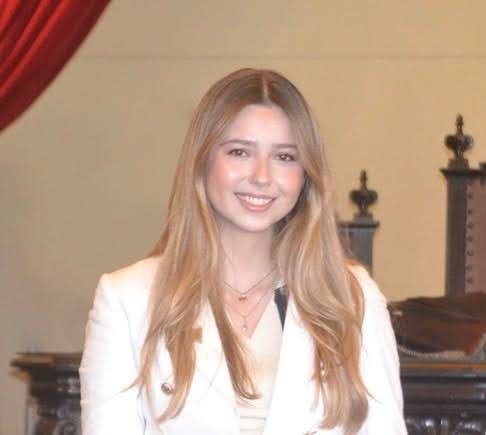
Now a few weeks into her first semester at Minerva University, Halytza is settling into San Francisco after moving from Curitiba, Paraná in southern Brazil.
She arrived with a love of running, visiting the beach, exploring coffee shops, reading classic literature, and relearning French compositions on the piano. Crime and Punishment is among her favorite books, and Kafka is one of her favorite authors.
“I’m unfortunately a very performative reader,” she joked. “I don’t really read romance. I just read those very performative books.”
Halytza enjoys spending time alone with a book and a cup of coffee as much as she enjoys meeting new people. That balance is part of what drew her to Minerva’s global community, where she can explore unfamiliar cities while building relationships with classmates from around the world.
Debate and Model United Nations (MUN) played a significant role in Halytza’s life before Minerva. She represented Brazil in international competitions, including the World Schools Debating Championships, and traveled to Doha, Qatar, for a forum that brought together young people to discuss challenges such as climate change and housing.
During a separate diplomatic event, Halytza was unexpectedly asked to replace a speaker who could no longer attend. She had 15 minutes to prepare a five-minute speech on an unfamiliar topic before addressing approximately 1,000 people. Only afterward did she fully understand who had been in the audience.
“One of the organizers came to me and said, ‘Did you see the Queen of Qatar standing there?’” Halytza recalled. “I was like, ‘Wait, what?’”
Halytza also earned one of five spots on Team Brazil for the World Schools Debating Championships, selected from a pool of approximately 600 applicants. Competing in Serbia and the Czech Republic connected her with young people from different cultures and strengthened her confidence in unfamiliar settings.
Together, these opportunities showed her how much she could accomplish when pushed beyond her comfort zone.
Her involvement in MUN also revealed a problem she wanted to address. When Haly began participating, she struggled to find clear and affordable MUN resources, particularly in Portuguese. She saw a significant gap between students who wanted to participate and those who could afford mentorship or had access to the right information.
Halytza began creating videos explaining MUN procedures, terminology and research strategies. Her TikTok community eventually grew to approximately 50,000 followers, with students messaging her to share how the videos helped them participate without paying for expensive mentorship programs.
“I like to joke that the mun platform is like Tinder, but for MUNs,” she said. “Whenever you want to find an MUN, you click and apply, and it’s a match.”
Her broader goal is to make educational opportunities more accessible to students in Brazil and beyond.
Minerva began to feel like the right fit after Halytza was admitted. Its holistic admissions process affirmed her belief that grades do not capture everything a student can contribute.
“My personal value is that grades don’t really define you,” she said. “Of course, it’s good to do well academically, but they don’t define you. There’s so much besides that.”
Halytza had also taken two gap years and appreciated that Minerva viewed the experiences she gained during that time as strengths. As she began meeting her classmates, the choice felt even more natural. Traveling for debates had already given her a glimpse of what it could be like to learn alongside people from around the world.
As she begins her first semester, Halytza is excited to study Japanese and German so she can engage more meaningfully with the communities she will encounter throughout Minerva’s global rotation.
Academically, she is particularly interested in double majoring in Economics & Society and Data Science, as well as exploring why education is more accessible in some places than others. She hopes Minerva’s global rotation and civic projects will help her compare educational systems across cultures and eventually create opportunities that reach more students.
For those considering Minerva but uncertain about choosing a less traditional path, Halytza’s advice is direct: “If there is any time in your life to take a risk, it’s now.” She sees Minerva as an opportunity to help shape what it can become.
That responsibility may also require students to explain Minerva’s global rotation and active learning model to people encountering the university for the first time. Halytza sees that as an advantage because it challenges students to articulate the value of their education and speak confidently about their experiences.
Whether adapting to a new city, contributing actively in class or introducing someone to an unfamiliar educational model, Halytza expects Minerva to continue pushing her beyond her comfort zone.
--
Ready to step outside your comfort zone and build an education that spans cultures, communities and cities? Learn more about Minerva University’s undergraduate experience here.
Quick Facts
Computational Sciences
Computational Sciences
Natural Sciences
Computational Sciences
Arts & Humanities, Natural Sciences
Social Sciences & Arts and Humanities
Business
Computational Sciences
Computational Sciences
Social Sciences & Business
Computational Sciences
Social Sciences
Computational Sciences & Business
Business & Computational Sciences
Computational Sciences
Computational Sciences
Social Sciences & Business
Business
Natural Sciences
Social Sciences
Social Sciences
Social Sciences & Business
Business & Computational Sciences
Business and Social Sciences
Social Sciences and Business
Computational Sciences & Social Sciences
Computer Science & Arts and Humanities
Business and Computational Sciences
Business and Social Sciences
Natural Sciences
Arts and Humanities
Business, Social Sciences
Business & Arts and Humanities
Computational Sciences
Natural Sciences, Computer Science
Computational Sciences
Arts & Humanities
Computational Sciences, Social Sciences
Computational Sciences
Computational Sciences
Natural Sciences, Social Sciences
Social Sciences, Natural Sciences
Data Science, Statistics
Computational Sciences
Business
Computational Sciences, Data Science
Social Sciences
Natural Sciences
Business, Natural Sciences
Business, Social Sciences
Computational Sciences
Arts & Humanities, Social Sciences
Social Sciences
Computational Sciences, Natural Sciences
Natural Sciences
Computational Sciences, Social Sciences
Business, Social Sciences
Computational Sciences
Natural Sciences, Social Sciences
Social Sciences
Arts & Humanities, Social Sciences
Arts & Humanities, Social Science
Social Sciences, Business
Arts & Humanities
Computational Sciences, Social Science
Natural Sciences, Computer Science
Computational Science, Statistic Natural Sciences
Business & Social Sciences
Sustainability
Sustainability
Natural Sciences & Sustainability
Natural Sciences
Sustainability
Computational Sciences
Computational Sciences
Computational Science & Business
Data Science and Statistics
Data Science and Statistics, Digital Practices
Earth and Environmental Systems
Cognition, Brain, and Behavior & Philosophy, Ethics, and the Law
Computational Theory and Analysis
Computer Science and Artificial Intelligence
Brand Management & Computer Science and Artificial Intelligence
Computer Science and Artificial Intelligence
Economics and Society & Strategic Finance
Enterprise Management
Economics and Society
Cells and Organisms & Brain, Cognition, and Behavior
Cognitive Science and Economics & Political Science
Applied Problem Solving & Computer Science and Artificial Intelligence
Computer Science and Artificial Intelligence & Cognition, Brain, and Behavior
Designing Societies & New Ventures
Strategic Finance & Data Science and Statistics
Brand Management and Designing Societies
Data Science & Economics
Machine Learning
Cells, Organisms, Data Science, Statistics
Arts & Literature and Historical Forces
Artificial Intelligence & Computer Science
Cells and Organisms, Mind and Emotion
Economics, Physics
Managing Operational Complexity and Strategic Finance
Global Development Studies and Brain, Cognition, and Behavior
Scalable Growth, Designing Societies
Business
Drug Discovery Research, Designing and Implementing Policies
Historical Forces, Cognition, Brain, and Behavior
Artificial Intelligence, Psychology
Designing Solutions, Data Science and Statistics
Data Science and Statistic, Theoretical Foundations of Natural Science
Strategic Finance, Politics, Government, and Society
Conversation
Now a few weeks into her first semester at Minerva University, Halytza is settling into San Francisco after moving from Curitiba, Paraná in southern Brazil.
She arrived with a love of running, visiting the beach, exploring coffee shops, reading classic literature, and relearning French compositions on the piano. Crime and Punishment is among her favorite books, and Kafka is one of her favorite authors.
“I’m unfortunately a very performative reader,” she joked. “I don’t really read romance. I just read those very performative books.”
Halytza enjoys spending time alone with a book and a cup of coffee as much as she enjoys meeting new people. That balance is part of what drew her to Minerva’s global community, where she can explore unfamiliar cities while building relationships with classmates from around the world.
Debate and Model United Nations (MUN) played a significant role in Halytza’s life before Minerva. She represented Brazil in international competitions, including the World Schools Debating Championships, and traveled to Doha, Qatar, for a forum that brought together young people to discuss challenges such as climate change and housing.
During a separate diplomatic event, Halytza was unexpectedly asked to replace a speaker who could no longer attend. She had 15 minutes to prepare a five-minute speech on an unfamiliar topic before addressing approximately 1,000 people. Only afterward did she fully understand who had been in the audience.
“One of the organizers came to me and said, ‘Did you see the Queen of Qatar standing there?’” Halytza recalled. “I was like, ‘Wait, what?’”
Halytza also earned one of five spots on Team Brazil for the World Schools Debating Championships, selected from a pool of approximately 600 applicants. Competing in Serbia and the Czech Republic connected her with young people from different cultures and strengthened her confidence in unfamiliar settings.
Together, these opportunities showed her how much she could accomplish when pushed beyond her comfort zone.
Her involvement in MUN also revealed a problem she wanted to address. When Haly began participating, she struggled to find clear and affordable MUN resources, particularly in Portuguese. She saw a significant gap between students who wanted to participate and those who could afford mentorship or had access to the right information.
Halytza began creating videos explaining MUN procedures, terminology and research strategies. Her TikTok community eventually grew to approximately 50,000 followers, with students messaging her to share how the videos helped them participate without paying for expensive mentorship programs.
“I like to joke that the mun platform is like Tinder, but for MUNs,” she said. “Whenever you want to find an MUN, you click and apply, and it’s a match.”
Her broader goal is to make educational opportunities more accessible to students in Brazil and beyond.
Minerva began to feel like the right fit after Halytza was admitted. Its holistic admissions process affirmed her belief that grades do not capture everything a student can contribute.
“My personal value is that grades don’t really define you,” she said. “Of course, it’s good to do well academically, but they don’t define you. There’s so much besides that.”
Halytza had also taken two gap years and appreciated that Minerva viewed the experiences she gained during that time as strengths. As she began meeting her classmates, the choice felt even more natural. Traveling for debates had already given her a glimpse of what it could be like to learn alongside people from around the world.
As she begins her first semester, Halytza is excited to study Japanese and German so she can engage more meaningfully with the communities she will encounter throughout Minerva’s global rotation.
Academically, she is particularly interested in double majoring in Economics & Society and Data Science, as well as exploring why education is more accessible in some places than others. She hopes Minerva’s global rotation and civic projects will help her compare educational systems across cultures and eventually create opportunities that reach more students.
For those considering Minerva but uncertain about choosing a less traditional path, Halytza’s advice is direct: “If there is any time in your life to take a risk, it’s now.” She sees Minerva as an opportunity to help shape what it can become.
That responsibility may also require students to explain Minerva’s global rotation and active learning model to people encountering the university for the first time. Halytza sees that as an advantage because it challenges students to articulate the value of their education and speak confidently about their experiences.
Whether adapting to a new city, contributing actively in class or introducing someone to an unfamiliar educational model, Halytza expects Minerva to continue pushing her beyond her comfort zone.
--
Ready to step outside your comfort zone and build an education that spans cultures, communities and cities? Learn more about Minerva University’s undergraduate experience here.