.png)


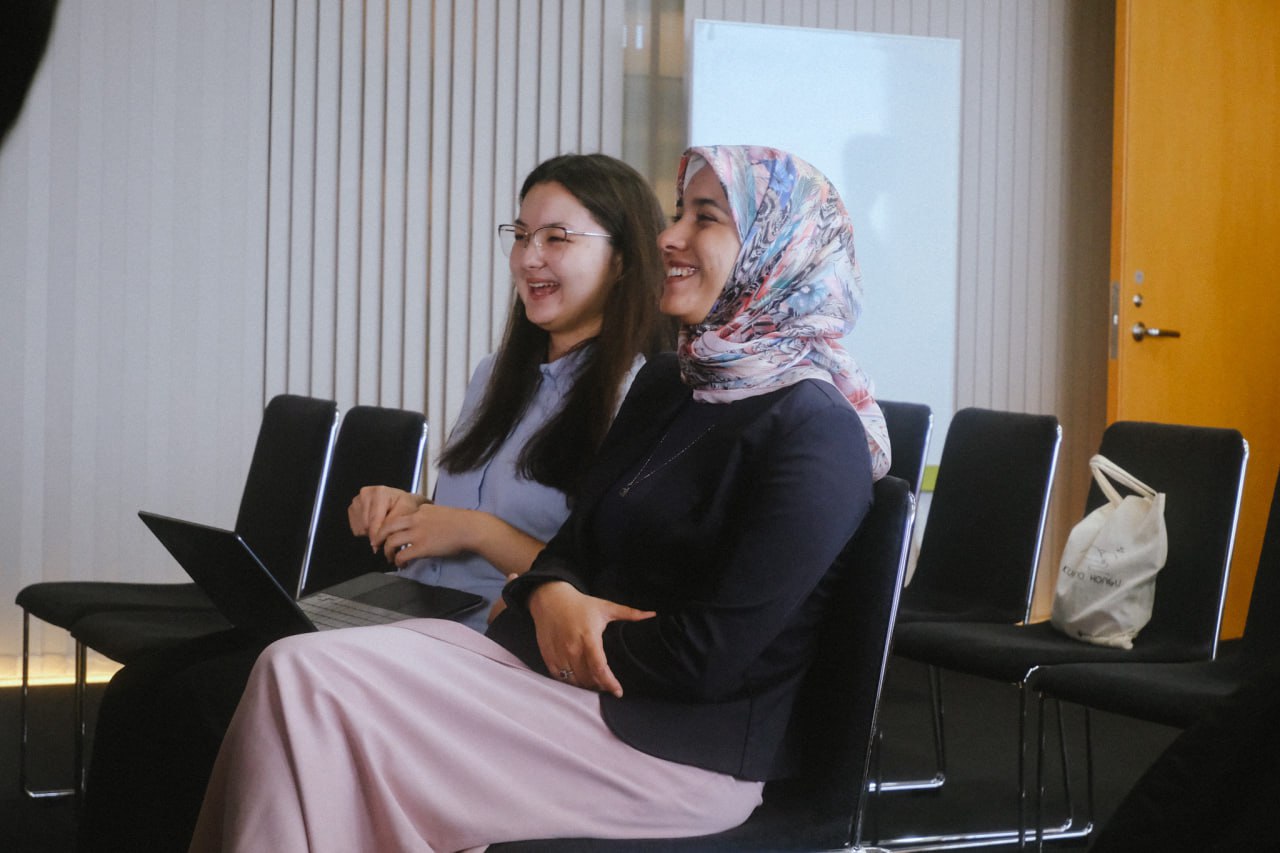
Aknur Abdikarim, Class of 2027, and Rawan Khalifa, Class of 2026, came to Tokyo to develop an AI application that tells people when their food is about to spoil. Two months later, they left with SpoilSense and a deeper understanding of what it takes to create technology that works in the real world.
Their project targeted SDG 12: Responsible Consumption and Production, specifically the goal to halve global food waste. The solution combined computer vision and machine learning to assess food freshness from images.
Tokyo's Food Culture as a Testing Ground
Tokyo immediately challenged their assumptions. The city's unique ingredients didn't match their training data. "We encountered local food types uncommon elsewhere - for example, aged tuna cheeks," Aknur explains. "Since the model’s dataset didn't include items like raw tuna cheeks, our model wasn't great at predicting their spoilage."
The model showed a consistent pattern: it underestimated freshness, giving shorter windows than reality. Aknur initially viewed this conservatism as a safety feature. Better to underestimate spoilage duration than risk eating spoiled items.
Then a Tokyo VC reframed the issue entirely. Underestimating freshness could still cause food waste, just from the opposite direction. People might discard perfectly good food based on overly cautious predictions.
"The city helped us gain a better understanding of how nuanced this 'simple application' can be," Aknur says. "You need to think of ethics, user habits, and local edge cases."
Rethinking Value and Impact
Meeting with Tokyo's innovation community shifted Aknur's thinking about what makes a project successful. Conversations with stakeholders and investors revealed that immediate profitability wasn't the only measure of value.
"I realized that projects don't always have to be profitable to be valuable, they can still make a real impact," she reflects. This realization freed the team to prioritize accuracy and usefulness over monetization strategies. Their focus became clear, to build something that genuinely helps people reduce waste and save money.
Navigating AI Ethics in Practice
The technical work raised questions without easy answers. When should the system prioritize caution over accuracy? How do you train models across culturally diverse food types? Where's the line between helpful guidance and wasteful over-caution?
The team addressed these challenges through iteration. They tested the application with real users, collected feedback from food experts and farmers, and refined their approach based on ground-level insights.
Continuing Development and First Funding
SpoilSense outlived the summer program. Aknur and Rawan kept building, incorporating stakeholder feedback and making steady improvements. Their persistence led to a breakthrough: following Dean Dosmann's recommendation, they applied to the Y-WORLD INNO-FORUM and secured their first funding.
"That was a big milestone for us," Aknur notes. The funding provides resources to keep developing while validating their approach.
The team's plans extend beyond this initial success. They're applying to additional competitions and continuing daily refinements. "We want to develop SpoilSense into a tool that can genuinely help people reduce food waste and save money, improving it a little more every day."
What Two Months in Tokyo Taught Them
The Sustainability Lab gave Aknur and Rawan the experience of watching a clean technical idea collide with messy reality. They discovered that effective AI applications require understanding local contexts, grappling with ethical trade-offs, and embracing unglamorous iteration.
SpoilSense began as a simple premise to predict when food spoils using AI. Through Tokyo, it became more sophisticated: a tool shaped by user needs, cultural considerations, and the practical challenges of solving sustainability problems across different contexts.
For this team, that's ongoing work. Each conversation with farmers, each model iteration, each user insight moves them closer to an application that meaningfully reduces global food waste.
If Aknur and Rawan's story inspired you, start your own Minerva journey today!
Quick Facts
Computational Sciences
Computational Sciences
Natural Sciences
Computational Sciences
Arts & Humanities, Natural Sciences
Social Sciences & Arts and Humanities
Business
Computational Sciences
Computational Sciences
Social Sciences & Business
Computational Sciences
Social Sciences
Computational Sciences & Business
Business & Computational Sciences
Computational Sciences
Computational Sciences
Social Sciences & Business
Business
Natural Sciences
Social Sciences
Social Sciences
Social Sciences & Business
Business & Computational Sciences
Business and Social Sciences
Social Sciences and Business
Computational Sciences & Social Sciences
Computer Science & Arts and Humanities
Business and Computational Sciences
Business and Social Sciences
Natural Sciences
Arts and Humanities
Business, Social Sciences
Business & Arts and Humanities
Computational Sciences
Natural Sciences, Computer Science
Computational Sciences
Arts & Humanities
Computational Sciences, Social Sciences
Computational Sciences
Computational Sciences
Natural Sciences, Social Sciences
Social Sciences, Natural Sciences
Data Science, Statistics
Computational Sciences
Business
Computational Sciences, Data Science
Social Sciences
Natural Sciences
Business, Natural Sciences
Business, Social Sciences
Computational Sciences
Arts & Humanities, Social Sciences
Social Sciences
Computational Sciences, Natural Sciences
Natural Sciences
Computational Sciences, Social Sciences
Business, Social Sciences
Computational Sciences
Natural Sciences, Social Sciences
Social Sciences
Arts & Humanities, Social Sciences
Arts & Humanities, Social Science
Social Sciences, Business
Arts & Humanities
Computational Sciences, Social Science
Natural Sciences, Computer Science
Computational Science, Statistic Natural Sciences
Business & Social Sciences
Sustainability
Sustainability
Natural Sciences & Sustainability
Natural Sciences
Sustainability
Computational Sciences
Computational Sciences
Computational Science & Business
Data Science and Statistics
Data Science and Statistics, Digital Practices
Earth and Environmental Systems
Cognition, Brain, and Behavior & Philosophy, Ethics, and the Law
Computational Theory and Analysis
Computer Science and Artificial Intelligence
Brand Management & Computer Science and Artificial Intelligence
Computer Science and Artificial Intelligence
Economics and Society & Strategic Finance
Enterprise Management
Economics and Society
Cells and Organisms & Brain, Cognition, and Behavior
Cognitive Science and Economics & Political Science
Applied Problem Solving & Computer Science and Artificial Intelligence
Computer Science and Artificial Intelligence & Cognition, Brain, and Behavior
Designing Societies & New Ventures
Strategic Finance & Data Science and Statistics
Brand Management and Designing Societies
Data Science & Economics
Machine Learning
Cells, Organisms, Data Science, Statistics
Arts & Literature and Historical Forces
Artificial Intelligence & Computer Science
Cells and Organisms, Mind and Emotion
Economics, Physics
Managing Operational Complexity and Strategic Finance
Global Development Studies and Brain, Cognition, and Behavior
Scalable Growth, Designing Societies
Business
Drug Discovery Research, Designing and Implementing Policies
Historical Forces, Cognition, Brain, and Behavior
Artificial Intelligence, Psychology
Designing Solutions, Data Science and Statistics
Data Science and Statistic, Theoretical Foundations of Natural Science
Strategic Finance, Politics, Government, and Society
Conversation
Aknur Abdikarim, Class of 2027, and Rawan Khalifa, Class of 2026, came to Tokyo to develop an AI application that tells people when their food is about to spoil. Two months later, they left with SpoilSense and a deeper understanding of what it takes to create technology that works in the real world.
Their project targeted SDG 12: Responsible Consumption and Production, specifically the goal to halve global food waste. The solution combined computer vision and machine learning to assess food freshness from images.
Tokyo's Food Culture as a Testing Ground
Tokyo immediately challenged their assumptions. The city's unique ingredients didn't match their training data. "We encountered local food types uncommon elsewhere - for example, aged tuna cheeks," Aknur explains. "Since the model’s dataset didn't include items like raw tuna cheeks, our model wasn't great at predicting their spoilage."
The model showed a consistent pattern: it underestimated freshness, giving shorter windows than reality. Aknur initially viewed this conservatism as a safety feature. Better to underestimate spoilage duration than risk eating spoiled items.
Then a Tokyo VC reframed the issue entirely. Underestimating freshness could still cause food waste, just from the opposite direction. People might discard perfectly good food based on overly cautious predictions.
"The city helped us gain a better understanding of how nuanced this 'simple application' can be," Aknur says. "You need to think of ethics, user habits, and local edge cases."
Rethinking Value and Impact
Meeting with Tokyo's innovation community shifted Aknur's thinking about what makes a project successful. Conversations with stakeholders and investors revealed that immediate profitability wasn't the only measure of value.
"I realized that projects don't always have to be profitable to be valuable, they can still make a real impact," she reflects. This realization freed the team to prioritize accuracy and usefulness over monetization strategies. Their focus became clear, to build something that genuinely helps people reduce waste and save money.
Navigating AI Ethics in Practice
The technical work raised questions without easy answers. When should the system prioritize caution over accuracy? How do you train models across culturally diverse food types? Where's the line between helpful guidance and wasteful over-caution?
The team addressed these challenges through iteration. They tested the application with real users, collected feedback from food experts and farmers, and refined their approach based on ground-level insights.
Continuing Development and First Funding
SpoilSense outlived the summer program. Aknur and Rawan kept building, incorporating stakeholder feedback and making steady improvements. Their persistence led to a breakthrough: following Dean Dosmann's recommendation, they applied to the Y-WORLD INNO-FORUM and secured their first funding.
"That was a big milestone for us," Aknur notes. The funding provides resources to keep developing while validating their approach.
The team's plans extend beyond this initial success. They're applying to additional competitions and continuing daily refinements. "We want to develop SpoilSense into a tool that can genuinely help people reduce food waste and save money, improving it a little more every day."
What Two Months in Tokyo Taught Them
The Sustainability Lab gave Aknur and Rawan the experience of watching a clean technical idea collide with messy reality. They discovered that effective AI applications require understanding local contexts, grappling with ethical trade-offs, and embracing unglamorous iteration.
SpoilSense began as a simple premise to predict when food spoils using AI. Through Tokyo, it became more sophisticated: a tool shaped by user needs, cultural considerations, and the practical challenges of solving sustainability problems across different contexts.
For this team, that's ongoing work. Each conversation with farmers, each model iteration, each user insight moves them closer to an application that meaningfully reduces global food waste.
If Aknur and Rawan's story inspired you, start your own Minerva journey today!