

.png)
For incoming Minerva students Kiyomi Koide and Sakura Matsuzuka, education has never been limited to the classroom.
This fall, both students will join Minerva University as Nippon Foundation Scholars, a distinction recognizing young leaders and innovators committed to contributing meaningfully to society. While their journeys have taken very different paths, both students share the belief that learning becomes most powerful when it connects directly to people, communities, and real-world challenges.
For Koide, that understanding emerged through firsthand experiences navigating alternative forms of education in Japan.

“At my previous school, I felt trapped in a rigid, standardized way of learning,” she said. “But after entering an online high school, I started to see real-world experience itself as a form of learning.”
After struggling to attend primary and middle school herself, Koide became involved with an NPO supporting students facing similar challenges. Her interests later expanded into inclusive education, mental health and environmental sustainability. Along the way, she developed a mental health app through an app competition, studied inclusive education practices in New Zealand through a scholarship supported by Japan’s Ministry of Education and earned a silver award at a national Philosophy Olympiad. Rather than viewing those experiences as disconnected, Koide sees them as part of a larger pattern.
“Looking back, I think I have consistently been drawn to approaching social problems across disciplines,” she said. That mindset has shaped projects ranging from building a student-company matching platform for digitally skilled high school students to designing programs that connected students with real-world public relations work in rural communities facing vacant housing challenges. “I am consistently drawn to identifying overlooked problems and testing new approaches to solve them,” she said.
For Matsuzuka, the desire to explore beyond familiar surroundings began much earlier, growing up in the countryside of Japan’s Mie Prefecture. In middle school, an English teacher who frequently traveled abroad introduced her to stories and perspectives far beyond her immediate community. “The many stories she shared about her experiences made me strongly want to see the world with my own eyes,” Matsuzuka said.
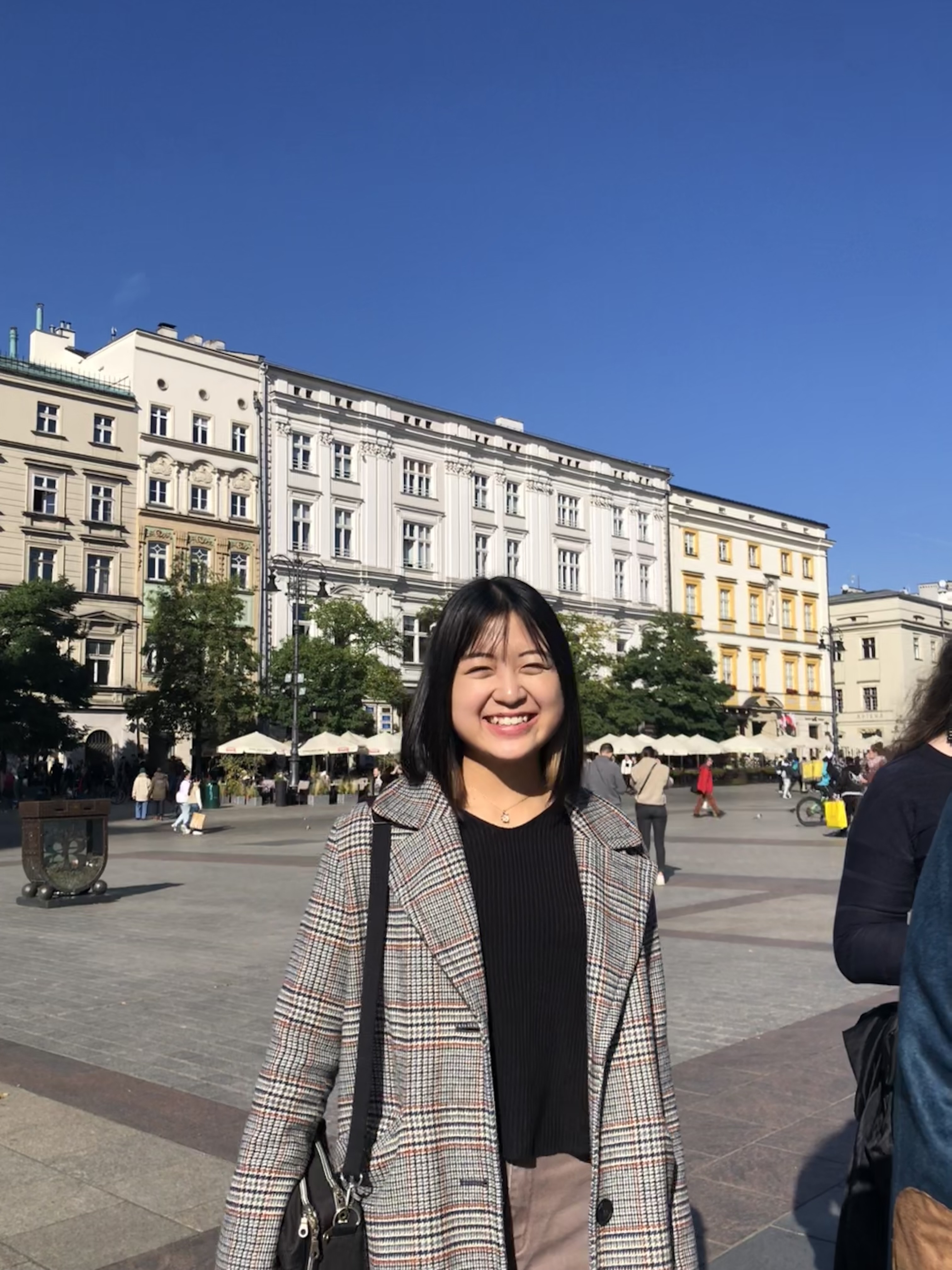
That curiosity eventually led her to attend United World College, an international boarding school community bringing together students from more than 100 countries.
“The more I connected with them, the more I realized that there were countless ways to chart one’s own life,” she said. One phrase in particular became central to how she thinks about her future: 人生は楽しく (Jinsei wa tanoshiku) — “you are the one who makes your own life fun.” The phrase, originally shared by her grandfather, became both a personal motto and a reminder that fulfillment does not come from following predetermined expectations, but from actively shaping one’s own path.
For both students, that openness to possibility continues to shape the impact they hope to make moving forward.
Koide has become increasingly focused on environmental sustainability, particularly at the intersection of technology, systems design and consumer awareness. “Japan’s increasingly extreme summer heat made the urgency of climate change feel much more immediate to me,” she said.
She believes solving environmental problems requires both large-scale infrastructure changes and better public understanding of the hidden systems behind everyday consumption. “People care when they know,” she said, referencing a lecture on ethical consumption that influenced her thinking. As part of that work, Koide recently created digital artwork visualizing issues such as carbon emissions and child labor in ways designed to make invisible systems more tangible to audiences.
Matsuzuka, meanwhile, hopes to help create a world where young people feel less pressure to follow narrowly defined paths. “As a kid, I hated growing up because I thought growing up would mean giving up many things by having to choose one realistic option,” she said. Over time, however, the people she encountered showed her that there is no single blueprint for success. “In the future, I hope to see a society where young people feel free to pursue their passions, without societal pressure or fears of going off the expected track,” she said.
Both students said Minerva’s model strongly aligned with the kind of learning experiences they were already seeking. Koide was drawn to Minerva’s emphasis on connecting learning directly to real-world projects and organizations. “I was strongly drawn to the way Minerva extends learning beyond the classroom,” she said. “It connects knowledge to the real world through fieldwork and projects with companies, NPOs, and other organizations.”
For Matsuzuka, Minerva’s global immersion model and diverse student community stood out immediately. “I look forward to not only living in different countries and immersing myself in local communities, but also connecting with peers from different parts of the world and hearing their unique stories,” she said.
Being selected as Nippon Foundation Scholars also carried deep personal significance for both students. Koide said that being recognized as a scholar is deeply meaningful to her because it feels like an affirmation of the unconventional path she’s taken. For Matsuzuka, “being selected as a Nippon Foundation Scholar, I am honored and lucky to be able to share my approach to life, being curious and fearless toward new and unfamiliar experiences.”
Looking ahead, both students hope to continue exploring questions that extend far beyond traditional academic boundaries. Koide hopes to keep working at the intersection of sustainability and technology, particularly around minimizing the environmental costs of emerging technologies like artificial intelligence. Matsuzuka remains focused on creating spaces where young people feel empowered to explore lives outside conventional expectations.
“Once they step out of their immediate communities, cultures or countries, there are no ‘standards,’ only countless options and possibilities,” she said.
For both students, the Nippon Foundation scholarship represents a recognition of past accomplishments and an opportunity to continue building toward the kind of impact they hope to create in the world.
Quick Facts
Computational Sciences
Computational Sciences
Natural Sciences
Computational Sciences
Arts & Humanities, Natural Sciences
Social Sciences & Arts and Humanities
Business
Computational Sciences
Computational Sciences
Social Sciences & Business
Computational Sciences
Social Sciences
Computational Sciences & Business
Business & Computational Sciences
Computational Sciences
Computational Sciences
Social Sciences & Business
Business
Natural Sciences
Social Sciences
Social Sciences
Social Sciences & Business
Business & Computational Sciences
Business and Social Sciences
Social Sciences and Business
Computational Sciences & Social Sciences
Computer Science & Arts and Humanities
Business and Computational Sciences
Business and Social Sciences
Natural Sciences
Arts and Humanities
Business, Social Sciences
Business & Arts and Humanities
Computational Sciences
Natural Sciences, Computer Science
Computational Sciences
Arts & Humanities
Computational Sciences, Social Sciences
Computational Sciences
Computational Sciences
Natural Sciences, Social Sciences
Social Sciences, Natural Sciences
Data Science, Statistics
Computational Sciences
Business
Computational Sciences, Data Science
Social Sciences
Natural Sciences
Business, Natural Sciences
Business, Social Sciences
Computational Sciences
Arts & Humanities, Social Sciences
Social Sciences
Computational Sciences, Natural Sciences
Natural Sciences
Computational Sciences, Social Sciences
Business, Social Sciences
Computational Sciences
Natural Sciences, Social Sciences
Social Sciences
Arts & Humanities, Social Sciences
Arts & Humanities, Social Science
Social Sciences, Business
Arts & Humanities
Computational Sciences, Social Science
Natural Sciences, Computer Science
Computational Science, Statistic Natural Sciences
Business & Social Sciences
Sustainability
Sustainability
Natural Sciences & Sustainability
Natural Sciences
Sustainability
Computational Sciences
Computational Sciences
Computational Science & Business
Data Science and Statistics
Data Science and Statistics, Digital Practices
Earth and Environmental Systems
Cognition, Brain, and Behavior & Philosophy, Ethics, and the Law
Computational Theory and Analysis
Computer Science and Artificial Intelligence
Brand Management & Computer Science and Artificial Intelligence
Computer Science and Artificial Intelligence
Economics and Society & Strategic Finance
Enterprise Management
Economics and Society
Cells and Organisms & Brain, Cognition, and Behavior
Cognitive Science and Economics & Political Science
Applied Problem Solving & Computer Science and Artificial Intelligence
Computer Science and Artificial Intelligence & Cognition, Brain, and Behavior
Designing Societies & New Ventures
Strategic Finance & Data Science and Statistics
Brand Management and Designing Societies
Data Science & Economics
Machine Learning
Cells, Organisms, Data Science, Statistics
Arts & Literature and Historical Forces
Artificial Intelligence & Computer Science
Cells and Organisms, Mind and Emotion
Economics, Physics
Managing Operational Complexity and Strategic Finance
Global Development Studies and Brain, Cognition, and Behavior
Scalable Growth, Designing Societies
Business
Drug Discovery Research, Designing and Implementing Policies
Historical Forces, Cognition, Brain, and Behavior
Artificial Intelligence, Psychology
Designing Solutions, Data Science and Statistics
Data Science and Statistic, Theoretical Foundations of Natural Science
Strategic Finance, Politics, Government, and Society
Conversation
For incoming Minerva students Kiyomi Koide and Sakura Matsuzuka, education has never been limited to the classroom.
This fall, both students will join Minerva University as Nippon Foundation Scholars, a distinction recognizing young leaders and innovators committed to contributing meaningfully to society. While their journeys have taken very different paths, both students share the belief that learning becomes most powerful when it connects directly to people, communities, and real-world challenges.
For Koide, that understanding emerged through firsthand experiences navigating alternative forms of education in Japan.
“At my previous school, I felt trapped in a rigid, standardized way of learning,” she said. “But after entering an online high school, I started to see real-world experience itself as a form of learning.”
After struggling to attend primary and middle school herself, Koide became involved with an NPO supporting students facing similar challenges. Her interests later expanded into inclusive education, mental health and environmental sustainability. Along the way, she developed a mental health app through an app competition, studied inclusive education practices in New Zealand through a scholarship supported by Japan’s Ministry of Education and earned a silver award at a national Philosophy Olympiad. Rather than viewing those experiences as disconnected, Koide sees them as part of a larger pattern.
“Looking back, I think I have consistently been drawn to approaching social problems across disciplines,” she said. That mindset has shaped projects ranging from building a student-company matching platform for digitally skilled high school students to designing programs that connected students with real-world public relations work in rural communities facing vacant housing challenges. “I am consistently drawn to identifying overlooked problems and testing new approaches to solve them,” she said.
For Matsuzuka, the desire to explore beyond familiar surroundings began much earlier, growing up in the countryside of Japan’s Mie Prefecture. In middle school, an English teacher who frequently traveled abroad introduced her to stories and perspectives far beyond her immediate community. “The many stories she shared about her experiences made me strongly want to see the world with my own eyes,” Matsuzuka said.
That curiosity eventually led her to attend United World College, an international boarding school community bringing together students from more than 100 countries.
“The more I connected with them, the more I realized that there were countless ways to chart one’s own life,” she said. One phrase in particular became central to how she thinks about her future: 人生は楽しく (Jinsei wa tanoshiku) — “you are the one who makes your own life fun.” The phrase, originally shared by her grandfather, became both a personal motto and a reminder that fulfillment does not come from following predetermined expectations, but from actively shaping one’s own path.
For both students, that openness to possibility continues to shape the impact they hope to make moving forward.
Koide has become increasingly focused on environmental sustainability, particularly at the intersection of technology, systems design and consumer awareness. “Japan’s increasingly extreme summer heat made the urgency of climate change feel much more immediate to me,” she said.
She believes solving environmental problems requires both large-scale infrastructure changes and better public understanding of the hidden systems behind everyday consumption. “People care when they know,” she said, referencing a lecture on ethical consumption that influenced her thinking. As part of that work, Koide recently created digital artwork visualizing issues such as carbon emissions and child labor in ways designed to make invisible systems more tangible to audiences.
Matsuzuka, meanwhile, hopes to help create a world where young people feel less pressure to follow narrowly defined paths. “As a kid, I hated growing up because I thought growing up would mean giving up many things by having to choose one realistic option,” she said. Over time, however, the people she encountered showed her that there is no single blueprint for success. “In the future, I hope to see a society where young people feel free to pursue their passions, without societal pressure or fears of going off the expected track,” she said.
Both students said Minerva’s model strongly aligned with the kind of learning experiences they were already seeking. Koide was drawn to Minerva’s emphasis on connecting learning directly to real-world projects and organizations. “I was strongly drawn to the way Minerva extends learning beyond the classroom,” she said. “It connects knowledge to the real world through fieldwork and projects with companies, NPOs, and other organizations.”
For Matsuzuka, Minerva’s global immersion model and diverse student community stood out immediately. “I look forward to not only living in different countries and immersing myself in local communities, but also connecting with peers from different parts of the world and hearing their unique stories,” she said.
Being selected as Nippon Foundation Scholars also carried deep personal significance for both students. Koide said that being recognized as a scholar is deeply meaningful to her because it feels like an affirmation of the unconventional path she’s taken. For Matsuzuka, “being selected as a Nippon Foundation Scholar, I am honored and lucky to be able to share my approach to life, being curious and fearless toward new and unfamiliar experiences.”
Looking ahead, both students hope to continue exploring questions that extend far beyond traditional academic boundaries. Koide hopes to keep working at the intersection of sustainability and technology, particularly around minimizing the environmental costs of emerging technologies like artificial intelligence. Matsuzuka remains focused on creating spaces where young people feel empowered to explore lives outside conventional expectations.
“Once they step out of their immediate communities, cultures or countries, there are no ‘standards,’ only countless options and possibilities,” she said.
For both students, the Nippon Foundation scholarship represents a recognition of past accomplishments and an opportunity to continue building toward the kind of impact they hope to create in the world.