.png)


.png)
Please tell us about your current work.
I'm currently part of the founding team of a space-tech startup called Space Renaissance (space-renaissance.ai). Founded just this past January 2026, we're a team of fewer than ten people working to support rocket development through software development. My own role spans both analysis engineering and business development.
During my time at Minerva, I developed an interest in working in the deep tech industry. Through a research internship, I began to wonder whether research works could be used for something useful outside of labs too. Space is a field that is shifting from research into industry, and the door was open for recent undergraduates as well.
The space-services sector is expanding, centered on satellite data and communications satellites. At the same time, the launch capacity that underpins it all has become a bottleneck. In Japan, roughly half of the country's own satellites are launched on overseas rockets, and outside of Japan, the wait for a launch slot can stretch years into the future. By building the simulation platforms, we're working to accelerate hardware development.
Why did you decide to attend Minerva?
What first drew me to Minerva was the Habits of Mind and Foundational Concepts (HCs). I was intrigued that I could learn 80 structured "modes of thinking,".
In high school, I took up forestry as an extracurricular activity—I earned the certification myself and thinned forests with a chainsaw. But whenever someone asked me, "Why do you want to do this?", I could never get past "because it's cool." I couldn't put my own motivation into words. I thought that if I learned the HCs, I might be able to reason more deeply and convey my own ideas to others.
What learning from your time at Minerva left the strongest impression on you?
A first-year foundational course introduced me to the idea of “complex systems”. Complex systems is the study of how individual elements influence one another to produce the behavior of a whole. At Minerva, it was introduced as a method for making sense of social phenomena—for example, how the connections between people shape public opinion.
Minerva encourages students to keep applying the HCs even after advancing into their specialized coursework. As I moved into my concentration in biology, I used the ideas of complex systems to interpret ecological data. That led, in the summer between my third and fourth years, to an internship at the Santa Fe Institute focused on complex-systems research, where I studied AI algorithms that mimic biological evolution. After graduating, I worked for a year as a research assistant doing environmental fieldwork in Florida, where I took on ecological network analysis.
While still a student, I wrote a paper as first author and submitted it after graduation. It wasn't accepted in the end, but being able to frame a question entirely from scratch and see a paper through to completion was a profound learning experience. I’m grateful that my foundational coursework led to research opportunities.

The complex-systems thinking I learned at Minerva led to environmental fieldwork in Florida, including prescribed burns for conservation. (Photo Credit: Hannah Bowen)
How does what you learned at Minerva show up in your current work?
What still anchors me is to keep learning on your own, and turn the learning into discussion. Minerva makes students prepare for every class in advance; makes students take new units every six months, and hold them to project-based results, and kept writing reports and my thesis. Diving into an unfamiliar field, rebuilding my understanding from the ground up, and moving forward through discussion with others—in fact, I'm doing exactly that now, catching up from scratch on the space industry and orbital mechanics. That posture of launching into a new field from zero is something my years at Minerva trained in me.
During your studies, did you work with any external partners—companies, local governments, NPOs, or local communities?
In the summer after my first year at Minerva, my classmates and I planned and ran a workshop for high school students called MINERVA JAPAN CARAVAN (https://www.recruit.co.jp/newsroom/2020y/0701_18739/). We gave students a taste of the Minerva style of learning under the theme of unconscious biases. Around 400 high schoolers from across Japan took part, and we were supported in building the program by HITOLAB, Recruit's HR R&D organization. With that support, we were able to deliver a part of what we'd learned at Minerva, in our own words, to high school students nationwide.
When it comes to ties with a local community, I also have fond memories of the rugby club I joined while living in Buenos Aires. Introduced by one of Minerva's local staff, I trained once a week alongside people from the area. Being welcomed into the local community like that is a memory I cherish.
In what areas do you hope to make your mark going forward?
First, getting this space startup—firmly off the ground. I want to grow as someone who can carry a new business forward. Until now, I could step into settings that were prepared for a fixed period, like a research internship, and give them my all. Now, together with teammates who share the same ambition, I'm building a company from nothing. It's a continuous process of trial and error, but I hope to carry it through to the point where I can call it "something we achieved ourselves."
Is there a message you'd like to share with partners in Japan considering working with Minerva?
Minerva students learn while moving through several cities around the world during their studies. In each new place, our local network is limited at first, and we rely on introductions from staff, connections we find on our own, and information online. The cities where I was able to connect with local people are the ones that remain the fondest memories.
What I'd most like to ask of partners is to become that "first point of connection." Through it, I believe ties rooted in communities across Japan can grow, and new exchanges can emerge. With partners who engage early on with Minerva's presence in Japan,I hope we can build a new community together for the coming Japanese cohort.
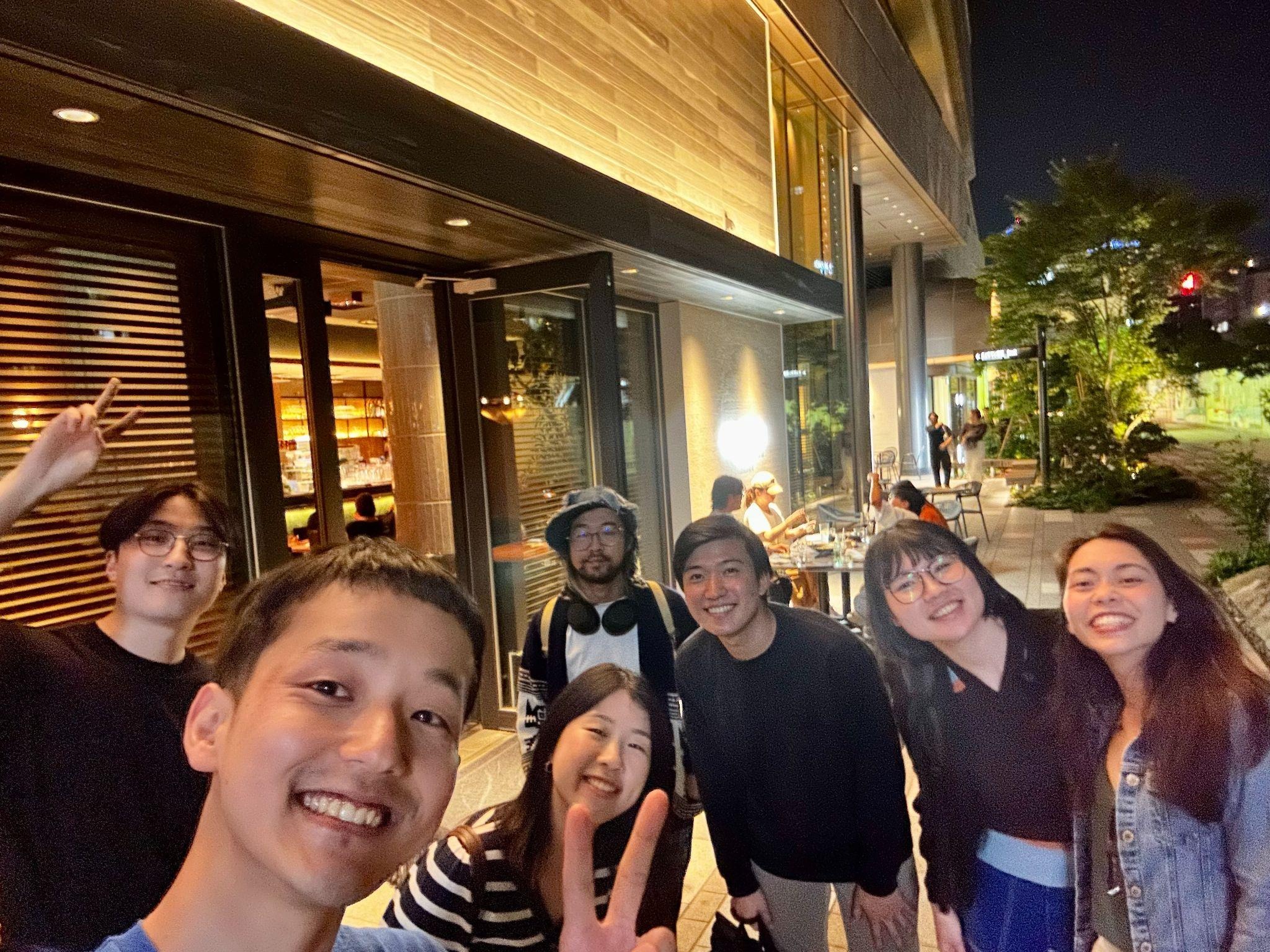
More alumni have returned to Tokyo, and reunions are now being held. Over the past few years, Japanese undergraduate alumni have grown to a few dozens—joining companies or the public sector, or heading to graduate school as they begin their careers.
--
Inspired by Yutaro's journey? Learn how Minerva University's global undergraduate experience empowers students to pursue ambitious careers in emerging industries.
Quick Facts
Computational Sciences
Computational Sciences
Natural Sciences
Computational Sciences
Arts & Humanities, Natural Sciences
Social Sciences & Arts and Humanities
Business
Computational Sciences
Computational Sciences
Social Sciences & Business
Computational Sciences
Social Sciences
Computational Sciences & Business
Business & Computational Sciences
Computational Sciences
Computational Sciences
Social Sciences & Business
Business
Natural Sciences
Social Sciences
Social Sciences
Social Sciences & Business
Business & Computational Sciences
Business and Social Sciences
Social Sciences and Business
Computational Sciences & Social Sciences
Computer Science & Arts and Humanities
Business and Computational Sciences
Business and Social Sciences
Natural Sciences
Arts and Humanities
Business, Social Sciences
Business & Arts and Humanities
Computational Sciences
Natural Sciences, Computer Science
Computational Sciences
Arts & Humanities
Computational Sciences, Social Sciences
Computational Sciences
Computational Sciences
Natural Sciences, Social Sciences
Social Sciences, Natural Sciences
Data Science, Statistics
Computational Sciences
Business
Computational Sciences, Data Science
Social Sciences
Natural Sciences
Business, Natural Sciences
Business, Social Sciences
Computational Sciences
Arts & Humanities, Social Sciences
Social Sciences
Computational Sciences, Natural Sciences
Natural Sciences
Computational Sciences, Social Sciences
Business, Social Sciences
Computational Sciences
Natural Sciences, Social Sciences
Social Sciences
Arts & Humanities, Social Sciences
Arts & Humanities, Social Science
Social Sciences, Business
Arts & Humanities
Computational Sciences, Social Science
Natural Sciences, Computer Science
Computational Science, Statistic Natural Sciences
Business & Social Sciences
Sustainability
Sustainability
Natural Sciences & Sustainability
Natural Sciences
Sustainability
Computational Sciences
Computational Sciences
Computational Science & Business
Data Science and Statistics
Data Science and Statistics, Digital Practices
Earth and Environmental Systems
Cognition, Brain, and Behavior & Philosophy, Ethics, and the Law
Computational Theory and Analysis
Computer Science and Artificial Intelligence
Brand Management & Computer Science and Artificial Intelligence
Computer Science and Artificial Intelligence
Economics and Society & Strategic Finance
Enterprise Management
Economics and Society
Cells and Organisms & Brain, Cognition, and Behavior
Cognitive Science and Economics & Political Science
Applied Problem Solving & Computer Science and Artificial Intelligence
Computer Science and Artificial Intelligence & Cognition, Brain, and Behavior
Designing Societies & New Ventures
Strategic Finance & Data Science and Statistics
Brand Management and Designing Societies
Data Science & Economics
Machine Learning
Cells, Organisms, Data Science, Statistics
Arts & Literature and Historical Forces
Artificial Intelligence & Computer Science
Cells and Organisms, Mind and Emotion
Economics, Physics
Managing Operational Complexity and Strategic Finance
Global Development Studies and Brain, Cognition, and Behavior
Scalable Growth, Designing Societies
Business
Drug Discovery Research, Designing and Implementing Policies
Historical Forces, Cognition, Brain, and Behavior
Artificial Intelligence, Psychology
Designing Solutions, Data Science and Statistics
Data Science and Statistic, Theoretical Foundations of Natural Science
Strategic Finance, Politics, Government, and Society
Conversation
Please tell us about your current work.
I'm currently part of the founding team of a space-tech startup called Space Renaissance (space-renaissance.ai). Founded just this past January 2026, we're a team of fewer than ten people working to support rocket development through software development. My own role spans both analysis engineering and business development.
During my time at Minerva, I developed an interest in working in the deep tech industry. Through a research internship, I began to wonder whether research works could be used for something useful outside of labs too. Space is a field that is shifting from research into industry, and the door was open for recent undergraduates as well.
The space-services sector is expanding, centered on satellite data and communications satellites. At the same time, the launch capacity that underpins it all has become a bottleneck. In Japan, roughly half of the country's own satellites are launched on overseas rockets, and outside of Japan, the wait for a launch slot can stretch years into the future. By building the simulation platforms, we're working to accelerate hardware development.
Why did you decide to attend Minerva?
What first drew me to Minerva was the Habits of Mind and Foundational Concepts (HCs). I was intrigued that I could learn 80 structured "modes of thinking,".
In high school, I took up forestry as an extracurricular activity—I earned the certification myself and thinned forests with a chainsaw. But whenever someone asked me, "Why do you want to do this?", I could never get past "because it's cool." I couldn't put my own motivation into words. I thought that if I learned the HCs, I might be able to reason more deeply and convey my own ideas to others.
What learning from your time at Minerva left the strongest impression on you?
A first-year foundational course introduced me to the idea of “complex systems”. Complex systems is the study of how individual elements influence one another to produce the behavior of a whole. At Minerva, it was introduced as a method for making sense of social phenomena—for example, how the connections between people shape public opinion.
Minerva encourages students to keep applying the HCs even after advancing into their specialized coursework. As I moved into my concentration in biology, I used the ideas of complex systems to interpret ecological data. That led, in the summer between my third and fourth years, to an internship at the Santa Fe Institute focused on complex-systems research, where I studied AI algorithms that mimic biological evolution. After graduating, I worked for a year as a research assistant doing environmental fieldwork in Florida, where I took on ecological network analysis.
While still a student, I wrote a paper as first author and submitted it after graduation. It wasn't accepted in the end, but being able to frame a question entirely from scratch and see a paper through to completion was a profound learning experience. I’m grateful that my foundational coursework led to research opportunities.
The complex-systems thinking I learned at Minerva led to environmental fieldwork in Florida, including prescribed burns for conservation. (Photo Credit: Hannah Bowen)
How does what you learned at Minerva show up in your current work?
What still anchors me is to keep learning on your own, and turn the learning into discussion. Minerva makes students prepare for every class in advance; makes students take new units every six months, and hold them to project-based results, and kept writing reports and my thesis. Diving into an unfamiliar field, rebuilding my understanding from the ground up, and moving forward through discussion with others—in fact, I'm doing exactly that now, catching up from scratch on the space industry and orbital mechanics. That posture of launching into a new field from zero is something my years at Minerva trained in me.
During your studies, did you work with any external partners—companies, local governments, NPOs, or local communities?
In the summer after my first year at Minerva, my classmates and I planned and ran a workshop for high school students called MINERVA JAPAN CARAVAN (https://www.recruit.co.jp/newsroom/2020y/0701_18739/). We gave students a taste of the Minerva style of learning under the theme of unconscious biases. Around 400 high schoolers from across Japan took part, and we were supported in building the program by HITOLAB, Recruit's HR R&D organization. With that support, we were able to deliver a part of what we'd learned at Minerva, in our own words, to high school students nationwide.
When it comes to ties with a local community, I also have fond memories of the rugby club I joined while living in Buenos Aires. Introduced by one of Minerva's local staff, I trained once a week alongside people from the area. Being welcomed into the local community like that is a memory I cherish.
In what areas do you hope to make your mark going forward?
First, getting this space startup—firmly off the ground. I want to grow as someone who can carry a new business forward. Until now, I could step into settings that were prepared for a fixed period, like a research internship, and give them my all. Now, together with teammates who share the same ambition, I'm building a company from nothing. It's a continuous process of trial and error, but I hope to carry it through to the point where I can call it "something we achieved ourselves."
Is there a message you'd like to share with partners in Japan considering working with Minerva?
Minerva students learn while moving through several cities around the world during their studies. In each new place, our local network is limited at first, and we rely on introductions from staff, connections we find on our own, and information online. The cities where I was able to connect with local people are the ones that remain the fondest memories.
What I'd most like to ask of partners is to become that "first point of connection." Through it, I believe ties rooted in communities across Japan can grow, and new exchanges can emerge. With partners who engage early on with Minerva's presence in Japan,I hope we can build a new community together for the coming Japanese cohort.
More alumni have returned to Tokyo, and reunions are now being held. Over the past few years, Japanese undergraduate alumni have grown to a few dozens—joining companies or the public sector, or heading to graduate school as they begin their careers.
--
Inspired by Yutaro's journey? Learn how Minerva University's global undergraduate experience empowers students to pursue ambitious careers in emerging industries.