


Polar snow modeling, conservation work in South Africa, and art–science exhibitions in Taiwan – at first glance, they feel unrelated. For Annabel Schön (M25), they all grew out of the same curiosity:
How do complex systems work, and how do we communicate them clearly?
From building numerical snow models in Finland to tracking leopards in the bush, Annabel’s path shows that scientific interests don’t always follow a straight line – and that unconventional routes often open meaningful opportunities.
From Capstone Curiosity to Professional Arctic Research
Annabel didn’t enter polar science through a traditional route. During her time at Minerva, she became increasingly drawn to remote Arctic environments and the mathematical tools used to study them. But without a built-in pathway for polar research, she had to create one.
“I read papers, made a list, and emailed 20 or 30 scientists around the world,” she said.
One of those cold emails led to Dr. Glen Liston at Colorado State University — a leading figure in snow modeling and now a long-term mentor.
This relationship shaped her Minerva capstone and opened the door to the work she does today.
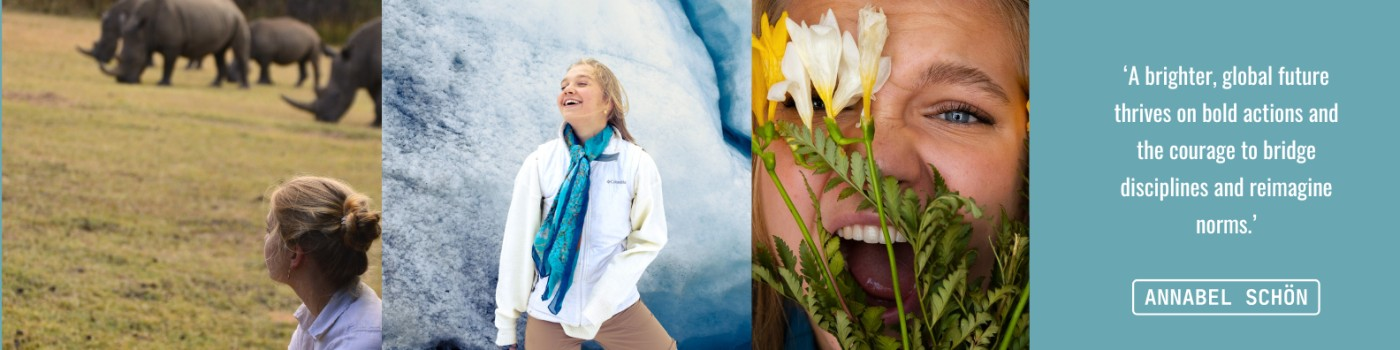
Today, Annabel is based in Helsinki, working at Finnish Meteorological Institute on numerical snowpack modeling. Her project focuses on advancing a Coupled Ice-Snow (CIS) model that simulates how snow accumulates, compacts, melts, and interacts with Arctic environments.
She is the youngest member of her 20-person team and is responsible for key components of the modeling effort – an uncommon level of autonomy for an early-career researcher.
As part of her funded research program, Annabel will soon head to the field to collect the measurements needed to test and refine her simulations.
As she put it, “I’m really excited to see how the math holds up in real Arctic conditions — grounding the model in what actually happens outside the lab.”
South Africa: Understanding Systems Through Observation
Before stepping into polar science, Annabel spent 1.5 months in South Africa, where she carried out conservation research using camera traps to track leopards. She produced ecological reports for reserve managers, focusing on migration pathways and population estimates crucial to wildlife management in fragmented farmland landscapes.
That experience helped her understand science as both analytical and observational.
“You can’t learn certain things from data alone — being in the field changes how you see patterns,” she said.
Creative Work as Scientific Communication
Threaded through Annabel’s scientific journey is her creative side. She co-founded Napkins (university-wide art magazine), organized an interdisciplinary art-science exhibition in Taiwan, and often thinks about narrative as a complementary research tool for scientific communication.
“Art helps you ask different questions,” she said. “It’s another way of understanding science, not separate from it.”
Courses That Shaped Her Interdisciplinary Identity
During Minerva, several classes built the intellectual foundation she now works from:
- NS156 Earth Systems Science with Prof. Zoogman
→ the class that pushed her into thinking deeply about planetary processes, feedback loops, and climate dynamics. - CS166 Modeling and Simulation
→ her introduction to numerical models and complex systems — the toolset that now underpins her research in Finland. - NS112 Evolution and NS144 Genetics
→ reinforcing her passion for biological systems and their elegant complexity.
She blended these fields outside class too — including through the Napkins and art exhibition — exploring how science and creative communication can build on each other.
Mentors Who Helped Shape the Path
Annabel credits much of her growth to mentors who challenged her to think beyond disciplinary boundaries.
- Dr. Glen Liston, her long-term mentor in snow physics
→ provided scientific guidance, helped her navigate uncertainties, and brought her into the world of Arctic modeling. - Prof. Wilkins, who encouraged her to embrace her hybrid identity
→ “You don’t fit the traditional box — and that’s your advantage.” - Prof. Tambasco, who supported her interest in both CS and NS
→ helping her believe she could succeed across quantitative and scientific domains, not just pick one.
Advice for Minerva Students
Annabel’s guidance for students interested in research — especially unconventional or emerging fields — is clear:
“Reach out early. Read papers. Email people. Even if you’re not doing a master’s yet, connect with the researchers at the forefront. Some of the best opportunities start with a single conversation.”
Looking Ahead
Annabel is now preparing to apply for graduate programs in polar and climate science. Her long-term vision is to keep working at the intersection of math modeling, fieldwork, and creative communication – bridging technical expertise with accessible storytelling.
Her journey shows that science can connect across different fields. It can be analytical and artistic, field-based and computational, structured and exploratory. And perhaps most importantly, it can be self-defined.
---
Ready to chart your own path? Explore how Minerva University helps students turn curiosity into meaningful global careers. Learn more about Minerva University.
Quick Facts
Computational Sciences
Computational Sciences
Natural Sciences
Computational Sciences
Arts & Humanities, Natural Sciences
Social Sciences & Arts and Humanities
Business
Computational Sciences
Computational Sciences
Social Sciences & Business
Computational Sciences
Social Sciences
Computational Sciences & Business
Business & Computational Sciences
Computational Sciences
Computational Sciences
Social Sciences & Business
Business
Natural Sciences
Social Sciences
Social Sciences
Social Sciences & Business
Business & Computational Sciences
Business and Social Sciences
Social Sciences and Business
Computational Sciences & Social Sciences
Computer Science & Arts and Humanities
Business and Computational Sciences
Business and Social Sciences
Natural Sciences
Arts and Humanities
Business, Social Sciences
Business & Arts and Humanities
Computational Sciences
Natural Sciences, Computer Science
Computational Sciences
Arts & Humanities
Computational Sciences, Social Sciences
Computational Sciences
Computational Sciences
Natural Sciences, Social Sciences
Social Sciences, Natural Sciences
Data Science, Statistics
Computational Sciences
Business
Computational Sciences, Data Science
Social Sciences
Natural Sciences
Business, Natural Sciences
Business, Social Sciences
Computational Sciences
Arts & Humanities, Social Sciences
Social Sciences
Computational Sciences, Natural Sciences
Natural Sciences
Computational Sciences, Social Sciences
Business, Social Sciences
Computational Sciences
Natural Sciences, Social Sciences
Social Sciences
Arts & Humanities, Social Sciences
Arts & Humanities, Social Science
Social Sciences, Business
Arts & Humanities
Computational Sciences, Social Science
Natural Sciences, Computer Science
Computational Science, Statistic Natural Sciences
Business & Social Sciences
Sustainability
Sustainability
Natural Sciences & Sustainability
Natural Sciences
Sustainability
Computational Sciences
Computational Sciences
Computational Science & Business
Data Science and Statistics
Data Science and Statistics, Digital Practices
Earth and Environmental Systems
Cognition, Brain, and Behavior & Philosophy, Ethics, and the Law
Computational Theory and Analysis
Computer Science and Artificial Intelligence
Brand Management & Computer Science and Artificial Intelligence
Computer Science and Artificial Intelligence
Economics and Society & Strategic Finance
Enterprise Management
Economics and Society
Cells and Organisms & Brain, Cognition, and Behavior
Cognitive Science and Economics & Political Science
Applied Problem Solving & Computer Science and Artificial Intelligence
Computer Science and Artificial Intelligence & Cognition, Brain, and Behavior
Designing Societies & New Ventures
Strategic Finance & Data Science and Statistics
Brand Management and Designing Societies
Data Science & Economics
Machine Learning
Cells, Organisms, Data Science, Statistics
Arts & Literature and Historical Forces
Artificial Intelligence & Computer Science
Cells and Organisms, Mind and Emotion
Economics, Physics
Managing Operational Complexity and Strategic Finance
Global Development Studies and Brain, Cognition, and Behavior
Scalable Growth, Designing Societies
Business
Drug Discovery Research, Designing and Implementing Policies
Historical Forces, Cognition, Brain, and Behavior
Artificial Intelligence, Psychology
Designing Solutions, Data Science and Statistics
Data Science and Statistic, Theoretical Foundations of Natural Science
Strategic Finance, Politics, Government, and Society
Conversation
Polar snow modeling, conservation work in South Africa, and art–science exhibitions in Taiwan – at first glance, they feel unrelated. For Annabel Schön (M25), they all grew out of the same curiosity:
How do complex systems work, and how do we communicate them clearly?
From building numerical snow models in Finland to tracking leopards in the bush, Annabel’s path shows that scientific interests don’t always follow a straight line – and that unconventional routes often open meaningful opportunities.
From Capstone Curiosity to Professional Arctic Research
Annabel didn’t enter polar science through a traditional route. During her time at Minerva, she became increasingly drawn to remote Arctic environments and the mathematical tools used to study them. But without a built-in pathway for polar research, she had to create one.
“I read papers, made a list, and emailed 20 or 30 scientists around the world,” she said.
One of those cold emails led to Dr. Glen Liston at Colorado State University — a leading figure in snow modeling and now a long-term mentor.
This relationship shaped her Minerva capstone and opened the door to the work she does today.
Today, Annabel is based in Helsinki, working at Finnish Meteorological Institute on numerical snowpack modeling. Her project focuses on advancing a Coupled Ice-Snow (CIS) model that simulates how snow accumulates, compacts, melts, and interacts with Arctic environments.
She is the youngest member of her 20-person team and is responsible for key components of the modeling effort – an uncommon level of autonomy for an early-career researcher.
As part of her funded research program, Annabel will soon head to the field to collect the measurements needed to test and refine her simulations.
As she put it, “I’m really excited to see how the math holds up in real Arctic conditions — grounding the model in what actually happens outside the lab.”
South Africa: Understanding Systems Through Observation
Before stepping into polar science, Annabel spent 1.5 months in South Africa, where she carried out conservation research using camera traps to track leopards. She produced ecological reports for reserve managers, focusing on migration pathways and population estimates crucial to wildlife management in fragmented farmland landscapes.
That experience helped her understand science as both analytical and observational.
“You can’t learn certain things from data alone — being in the field changes how you see patterns,” she said.
Creative Work as Scientific Communication
Threaded through Annabel’s scientific journey is her creative side. She co-founded Napkins (university-wide art magazine), organized an interdisciplinary art-science exhibition in Taiwan, and often thinks about narrative as a complementary research tool for scientific communication.
“Art helps you ask different questions,” she said. “It’s another way of understanding science, not separate from it.”
Courses That Shaped Her Interdisciplinary Identity
During Minerva, several classes built the intellectual foundation she now works from:
- NS156 Earth Systems Science with Prof. Zoogman
→ the class that pushed her into thinking deeply about planetary processes, feedback loops, and climate dynamics. - CS166 Modeling and Simulation
→ her introduction to numerical models and complex systems — the toolset that now underpins her research in Finland. - NS112 Evolution and NS144 Genetics
→ reinforcing her passion for biological systems and their elegant complexity.
She blended these fields outside class too — including through the Napkins and art exhibition — exploring how science and creative communication can build on each other.
Mentors Who Helped Shape the Path
Annabel credits much of her growth to mentors who challenged her to think beyond disciplinary boundaries.
- Dr. Glen Liston, her long-term mentor in snow physics
→ provided scientific guidance, helped her navigate uncertainties, and brought her into the world of Arctic modeling. - Prof. Wilkins, who encouraged her to embrace her hybrid identity
→ “You don’t fit the traditional box — and that’s your advantage.” - Prof. Tambasco, who supported her interest in both CS and NS
→ helping her believe she could succeed across quantitative and scientific domains, not just pick one.
Advice for Minerva Students
Annabel’s guidance for students interested in research — especially unconventional or emerging fields — is clear:
“Reach out early. Read papers. Email people. Even if you’re not doing a master’s yet, connect with the researchers at the forefront. Some of the best opportunities start with a single conversation.”
Looking Ahead
Annabel is now preparing to apply for graduate programs in polar and climate science. Her long-term vision is to keep working at the intersection of math modeling, fieldwork, and creative communication – bridging technical expertise with accessible storytelling.
Her journey shows that science can connect across different fields. It can be analytical and artistic, field-based and computational, structured and exploratory. And perhaps most importantly, it can be self-defined.
---
Ready to chart your own path? Explore how Minerva University helps students turn curiosity into meaningful global careers. Learn more about Minerva University.